JENN SLATER

Mortgage Associate

APPLY NOW
Looking for a Great Mortgage?

I help people across Saskatchewan find the best mortgage product for their unique needs! I would love to work with you!

Understanding mortgage financing can be difficult, it doesn't have to be. Here's the plan!

1

Connect with me 

The process starts when you get in touch. Let's take a look at your financial situation and put together a plan to find your perfect mortgage!

2

Discuss your options.

When it comes to mortgage financing, you have options! Let's clarify those options, so you can make the decision that best suits your needs.

3

Arrange the paperwork

Paperwork is the nitty gritty of mortgage financing. I will make sure you know what is required, limiting delays.

4

Lifetime support

Once I've arranged your mortgage, and as long as you need a mortgage, you can trust that I will be there to give you a hand.

Jenn (Arcand) Slater

Mortgage Associate
License #316444

JENN SLATER

Hi, my name is Jenn Slater. I’m a mortgage associate with oneSt. Mortgage, a proud franchise of one of Canada’s most well respected Broker Networks, Mortgage Architects. I work from my office in Saskatoon, Saskatchewan. I started my career in finance in the early 2000s and have worked in many advisory positions at major banks and for the credit unions, most recently as a financial planner. I became a licensed mortgage associate because it was important for me to focus my full attention on helping my clients with their unique situations.


My extensive financial experience allows me to see the bigger picture and find solutions and options for my clients that they might not have otherwise found. Working with multiple lenders (instead of just one) has a significant advantage in that I provide incredible options to every client. Each client is different, I understand that and as such take the time to get to know each client individually and provide a mortgage solution tailored to them.


When I’m not assisting my clients finance their dreams, I enjoy ALL kinds of music from country to big hair rock to classical, music is a must while I work. I love pop culture, coffee in the morning, golf in the summer, and a nice glass of red wine anytime! Have a look at my website and contact me when you are ready to talk!

Nice things people have said about working with me.

Get started by completing my online mortgage application.

APPLY NOW

I'll let you know exactly where you stand so you can proceed with confidence.

Download my Mortgage Toolbox App
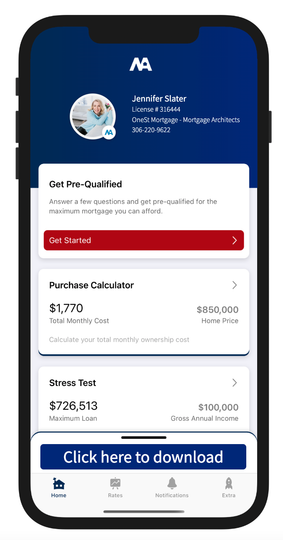
What you can do with my app


Calculate your total cost of owning a home

Estimate the minimum down payment you need

Calculate Land transfer taxes and the available rebates

Calculate the maximum loan you can borrow

Stress test your mortgage

Estimate your Closing costs

Compare your options side by side

Search for the best mortgage rates

Email Summary reports (PDF)

Use my app in English, French, Spanish, Hindi, and Chinese

Everything you need, all in one place

As a trusted mortgage provider, let me help you with these services.

Click through any of the services to learn more

Mortgage articles to keep you informed.

By Jenn Slater January 28, 2026
Bank of Canada maintains policy rate at 2¼%. FOR IMMEDIATE RELEASE Media Relations Ottawa, Ontario January 28, 2026 The Bank of Canada today held its target for the overnight rate at 2.25%, with the Bank Rate at 2.5% and the deposit rate at 2.20%. The outlook for the global and Canadian economies is little changed relative to the projection in the October Monetary Policy Report (MPR). However, the outlook is vulnerable to unpredictable US trade policies and geopolitical risks. Economic growth in the United States continues to outpace expectations and is projected to remain solid, driven by AI-related investment and consumer spending. Tariffs are pushing up US inflation, although their effect is expected to fade gradually later this year. In the euro area, growth has been supported by activity in service sectors and will get additional support from fiscal policy. China’s GDP growth is expected to slow gradually, as weakening domestic demand offsets strength in exports. Overall, the Bank expects global growth to average about 3% over the projection horizon. Global financial conditions have remained accommodative overall. Recent weakness in the US dollar has pushed the Canadian dollar above 72 cents, roughly where it had been since the October MPR. Oil prices have been fluctuating in response to geopolitical events and, going forward, are assumed to be slightly below the levels in the October report. US trade restrictions and uncertainty continue to disrupt growth in Canada. After a strong third quarter, GDP growth in the fourth quarter likely stalled. Exports continue to be buffeted by US tariffs, while domestic demand appears to be picking up. Employment has risen in recent months. Still, the unemployment rate remains elevated at 6.8% and relatively few businesses say they plan to hire more workers. Economic growth is projected to be modest in the near term as population growth slows and Canada adjusts to US protectionism. In the projection, consumer spending holds up and business investment strengthens gradually, with fiscal policy providing some support. The Bank projects growth of 1.1% in 2026 and 1.5% in 2027, broadly in line with the October projection. A key source of uncertainty is the upcoming review of the Canada-US-Mexico Agreement. CPI inflation picked up in December to 2.4%, boosted by base-year effects linked to last winter’s GST/HST holiday. Excluding the effect of changes in taxes, inflation has been slowing since September. The Bank’s preferred measures of core inflation have eased from 3% in October to around 2½% in December. Inflation was 2.1% in 2025 and the Bank expects inflation to stay close to the 2% target over the projection period, with trade-related cost pressures offset by excess supply. Monetary policy is focused on keeping inflation close to the 2% target while helping the economy through this period of structural adjustment. Governing Council judges the current policy rate remains appropriate, conditional on the economy evolving broadly in line with the outlook we published today. However, uncertainty is heightened and we are monitoring risks closely. If the outlook changes, we are prepared to respond. The Bank is committed to ensuring that Canadians continue to have confidence in price stability through this period of global upheaval. Information note The next scheduled date for announcing the overnight rate target is March 18, 2026. The Bank’s next MPR will be released on April 29, 2026. Read the January 28th, 2026 Monetary Report
By Jenn Slater January 22, 2026
Need to Free Up Some Cash? Your Home Equity Could Help If you've owned your home for a while, chances are it’s gone up in value. That increase—paired with what you’ve already paid down—is called home equity, and it’s one of the biggest financial advantages of owning property. Still, many Canadians don’t realize they can tap into that equity to improve their financial flexibility, fund major expenses, or support life goals—all without selling their home. Let’s break down what home equity is and how you might be able to use it to your advantage. First, What Is Home Equity? Home equity is the difference between what your home is worth and what you still owe on it. Example: If your home is valued at $700,000 and you owe $200,000 on your mortgage, you have $500,000 in equity . That’s real financial power—and depending on your situation, there are a few smart ways to access it. Option 1: Refinance Your Mortgage A traditional mortgage refinance is one of the most common ways to tap into your home’s equity. If you qualify, you can borrow up to 80% of your home’s appraised value , minus what you still owe. Example: Your home is worth $600,000 You owe $350,000 You can refinance up to $480,000 (80% of $600K) That gives you access to $130,000 in equity You’ll pay off your existing mortgage and take the difference as a lump sum, which you can use however you choose—renovations, investments, debt consolidation, or even a well-earned vacation. Even if your mortgage is fully paid off, you can still refinance and borrow against your home’s value. Option 2: Consider a Reverse Mortgage (Ages 55+) If you're 55 or older, a reverse mortgage could be a flexible way to access tax-free cash from your home—without needing to make monthly payments. You keep full ownership of your home, and the loan only becomes repayable when you sell, move out, or pass away. While you won’t be able to borrow as much as a conventional refinance (the exact amount depends on your age and property value), this option offers freedom and peace of mind—especially for retirees who are equity-rich but cash-flow tight. Reverse mortgage rates are typically a bit higher than traditional mortgages, but you won’t need to pass income or credit checks to qualify. Option 3: Open a Home Equity Line of Credit (HELOC) Think of a HELOC as a reusable credit line backed by your home. You get approved for a set amount, and only pay interest on what you actually use. Need $10,000 for a new roof? Use the line. Don’t need anything for six months? No payments required. HELOCs offer flexibility and low interest rates compared to personal loans or credit cards. But they can be harder to qualify for and typically require strong credit, stable income, and a solid debt ratio. Option 4: Get a Second Mortgage Let’s say you’re mid-term on your current mortgage and breaking it would mean hefty penalties. A second mortgage could be a temporary solution. It allows you to borrow a lump sum against your home’s equity, without touching your existing mortgage. Second mortgages usually come with higher interest rates and shorter terms, so they’re best suited for short-term needs like bridging a gap, paying off urgent debt, or funding a one-time project. So, What’s Right for You? There’s no one-size-fits-all solution. The right option depends on your financial goals, your current mortgage, your credit, and how much equity you have available. We’re here to walk you through your choices and help you find a strategy that works best for your situation. Ready to explore your options? Let’s talk about how your home’s equity could be working harder for you. No pressure, no obligation—just solid advice.
By Jenn Slater January 15, 2026
Ready to Buy Your First Home? Here’s How to Know for Sure Buying your first home is exciting—but it’s also a major financial decision. So how can you tell if you’re truly ready to take that leap into homeownership? Whether you’re confident or still unsure, these four signs are solid indicators that you’re on the right path: 1. You’ve Got Your Down Payment and Closing Costs in Place To purchase a home in Canada, you’ll need at least 5% of the purchase price as a down payment. In addition, plan for around 1.5% to 2% of the home’s value to cover closing costs like legal fees, insurance, and adjustments. If you’ve managed to save this on your own, that’s a great sign of financial discipline. If you're receiving help from a family member through a gifted down payment , that works too—as long as the paperwork is in order. Either way, having these funds ready shows you’re prepared for the upfront costs of homeownership. 2. Your Credit Profile Tells a Good Story Lenders want to know how you manage debt. Before they approve you for a mortgage, they’ll review your credit history. What they typically like to see: At least two active credit accounts (trade lines) , like a credit card or loan Each with a minimum limit of $2,000 Open and active for at least 2 years Even if your credit isn’t perfect, don’t panic. There may still be options, such as using a co-signer or working on a credit improvement plan with a mortgage expert. 3. Your Income Can Support Homeownership—Comfortably A steady income is essential, but not all income is treated equally. If you’re full-time and past probation , you’re in a strong position. If you’re self-employed, on contract, or rely on variable income like tips or commissions, you’ll generally need a two-year history to qualify. A general rule: housing costs (mortgage, taxes, utilities) should stay under 35% of your gross monthly income . That leaves plenty of room for other living expenses, savings, and—yes—some fun too. 4. You’ve Talked to a Mortgage Professional Let’s be real—there’s a lot of info out there about buying a home. Google searches and TikToks can only take you so far. If you're serious about buying, speaking with a mortgage professional is the most effective next step. Why? Because you'll: Get pre-approved (and know what price range you're working with) Understand your loan options and the qualification process Build a game plan that suits your timeline and financial goals The Bottom Line: Being “ready” to buy a home isn’t just about how much you want it—it’s about being financially prepared, credit-ready, and backed by expert advice. If you’re thinking about homeownership, let’s chat. I’d love to help you understand your options, crunch the numbers, and build a plan that gets you confidently across the finish line—keys in hand.
Show More