JENN SLATER

Mortgage Associate

APPLY NOW
Looking for a Great Mortgage?

I help people across Saskatchewan find the best mortgage product for their unique needs! I would love to work with you!

Understanding mortgage financing can be difficult, it doesn't have to be. Here's the plan!

1

Connect with me 

The process starts when you get in touch. Let's take a look at your financial situation and put together a plan to find your perfect mortgage!

2

Discuss your options.

When it comes to mortgage financing, you have options! Let's clarify those options, so you can make the decision that best suits your needs.

3

Arrange the paperwork

Paperwork is the nitty gritty of mortgage financing. I will make sure you know what is required, limiting delays.

4

Lifetime support

Once I've arranged your mortgage, and as long as you need a mortgage, you can trust that I will be there to give you a hand.

Jenn (Arcand) Slater

Mortgage Associate
License #316444

JENN SLATER

Hi, my name is Jenn Slater. I’m a mortgage associate with oneSt. Mortgage, a proud franchise of one of Canada’s most well respected Broker Networks, Mortgage Architects. I work from my office in Saskatoon, Saskatchewan. I started my career in finance in the early 2000s and have worked in many advisory positions at major banks and for the credit unions, most recently as a financial planner. I became a licensed mortgage associate because it was important for me to focus my full attention on helping my clients with their unique situations.


My extensive financial experience allows me to see the bigger picture and find solutions and options for my clients that they might not have otherwise found. Working with multiple lenders (instead of just one) has a significant advantage in that I provide incredible options to every client. Each client is different, I understand that and as such take the time to get to know each client individually and provide a mortgage solution tailored to them.


When I’m not assisting my clients finance their dreams, I enjoy ALL kinds of music from country to big hair rock to classical, music is a must while I work. I love pop culture, coffee in the morning, golf in the summer, and a nice glass of red wine anytime! Have a look at my website and contact me when you are ready to talk!

Nice things people have said about working with me.

Get started by completing my online mortgage application.

APPLY NOW

I'll let you know exactly where you stand so you can proceed with confidence.

Download my Mortgage Toolbox App
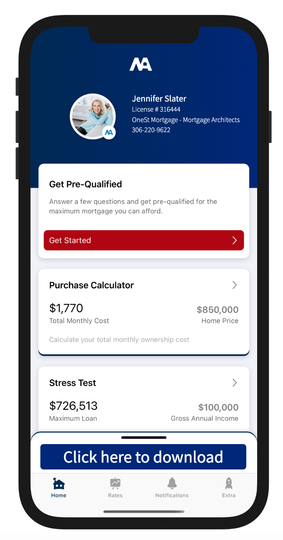
What you can do with my app


Calculate your total cost of owning a home

Estimate the minimum down payment you need

Calculate Land transfer taxes and the available rebates

Calculate the maximum loan you can borrow

Stress test your mortgage

Estimate your Closing costs

Compare your options side by side

Search for the best mortgage rates

Email Summary reports (PDF)

Use my app in English, French, Spanish, Hindi, and Chinese

Everything you need, all in one place

As a trusted mortgage provider, let me help you with these services.

Click through any of the services to learn more

Mortgage articles to keep you informed.

By Jenn Slater December 11, 2025
Why the Cheapest Mortgage Isn’t Always the Smartest Move Some things are fine to buy on the cheap. Generic cereal? Sure. Basic airline seat? No problem. A car with roll-down windows? If it gets you where you're going, great. But when it comes to choosing a mortgage? That’s not the time to cut corners. A “no-frills” mortgage might sound appealing with its rock-bottom interest rate, but what’s stripped away to get you that rate can end up costing you far more in the long run. These mortgages often come with severe limitations—restrictions that could hit your wallet hard if life throws you a curveball. Let’s break it down. A typical no-frills mortgage might offer a slightly lower interest rate—maybe 0.10% to 0.20% less. That could save you a few hundred dollars over a few years. But that small upfront saving comes at the cost of flexibility: Breaking your mortgage early? Expect a massive penalty. Want to make extra payments? Often not allowed—or severely restricted. Need to move and take your mortgage with you? Not likely. Thinking about refinancing? Good luck doing that without a financial hit. Most people don’t plan on breaking their mortgage early—but roughly two-thirds of Canadians do, often due to job changes, separations, relocations, or expanding families. That’s why flexibility matters. So why do lenders even offer no-frills mortgages? Because they know the stats. And they know many borrowers chase the lowest rate without asking what’s behind it. Some banks count on that. Their job is to maximize profits. Ours? To help you make an informed, strategic choice. As independent mortgage professionals, we work for you—not a single lender. That means we can compare multiple products from various financial institutions to find the one that actually suits your goals and protects your long-term financial health. Bottom line: Don’t let a shiny low rate distract you from what really matters. A mortgage should fit your life—not the other way around. Have questions? Want to look at your options? I’d be happy to help. Let’s chat.
By Jenn Slater December 4, 2025
Going Through a Separation? Here’s What You Need to Know About Your Mortgage Separation or divorce can be one of life’s most stressful transitions—and when real estate is involved, the financial side of things can get complicated fast. If you and your partner own a home together, figuring out what happens next with your mortgage is a critical step in moving forward. Here’s what you need to know: You’re Still Responsible for Mortgage Payments Even if your relationship changes, your obligation to your mortgage lender doesn’t. If your name is on the mortgage, you’re fully responsible for making sure payments continue. Missed payments can lead to penalties, damage your credit, or even put your home at risk of foreclosure. If you relied on your partner to handle payments during the relationship, now is the time to take a proactive role. Contact your lender directly to confirm everything is on track. Breaking or Changing Your Mortgage Comes With Costs Dividing your finances might mean refinancing, removing someone from the title, or selling the home. All of these options come with potential legal fees, appraisal costs, and mortgage penalties—especially if you’re mid-term with a fixed-rate mortgage. Before making any decisions, speak with your lender to get a clear picture of the potential costs. This info can be helpful when finalizing your separation agreement. Legal Status Affects Financing If you're applying for a new mortgage after a separation, lenders will want to see official documentation—like a signed separation agreement or divorce decree. These documents help the lender assess any ongoing financial obligations like child or spousal support, which may impact your ability to qualify. No paperwork yet? Expect delays and added scrutiny in the mortgage process until everything is finalized. Qualifying on One Income Can Be Tougher Many couples qualify for mortgages based on combined income. After a separation, your borrowing power may decrease if you're now applying solo. This can affect your ability to buy a new home or stay in the one you currently own. A mortgage professional can help you reassess your financial picture and identify options that make sense for your situation—whether that means buying on your own, co-signing with a family member, or exploring government programs. Buying Out Your Partner? You May Have Extra Flexibility In cases where one person wants to stay in the home, lenders may offer special flexibility. Unlike traditional refinancing, which typically caps borrowing at 80% of the home’s value, a “spousal buyout” may allow you to access up to 95%—making it easier to compensate your former partner and retain the home. This option is especially useful for families looking to minimize disruption for children or maintain community ties. You Don’t Have to Figure It Out Alone Separation is never simple—but with the right support, you can move forward with clarity and confidence. Whether you’re keeping the home, selling, or starting fresh, working with a mortgage professional can help you understand your options and create a strategy that aligns with your new goals. Let’s talk through your situation and explore the best path forward. I’m here to help.
By Jenn Slater November 27, 2025
Thinking About Buying a Home? Here’s What to Know Before You Start Whether you're buying your very first home or preparing for your next move, the process can feel overwhelming—especially with so many unknowns. But it doesn’t have to be. With the right guidance and preparation, you can approach your home purchase with clarity and confidence. This article will walk you through a high-level overview of what lenders look for and what you’ll need to consider in the early stages of buying a home. Once you’re ready to move forward with a pre-approval, we’ll dive into the details together. 1. Are You Credit-Ready? One of the first things a lender will evaluate is your credit history. Your credit profile helps determine your risk level—and whether you're likely to repay your mortgage as agreed. To be considered “established,” you’ll need: At least two active credit accounts (like credit cards, loans, or lines of credit) Each with a minimum limit of $2,500 Reporting for at least two years Just as important: your repayment history. Make all your payments on time, every time. A missed payment won’t usually impact your credit unless you’re 30 days or more past due—but even one slip can lower your score. 2. Is Your Income Reliable? Lenders are trusting you with hundreds of thousands of dollars, so they want to be confident that your income is stable enough to support regular mortgage payments. Salaried employees in permanent positions generally have the easiest time qualifying. If you’re self-employed, or your income includes commission, overtime, or bonuses, expect to provide at least two years’ worth of income documentation. The more predictable your income, the easier it is to qualify. 3. What’s Your Down Payment Plan? Every mortgage requires some amount of money upfront. In Canada, the minimum down payment is: 5% on the first $500,000 of the purchase price 10% on the portion above $500,000 20% for homes over $1 million You’ll also need to show proof of at least 1.5% of the purchase price for closing costs (think legal fees, appraisals, and taxes). The best source of a down payment is your own savings, supported by a 90-day history in your bank account. But gifted funds from immediate family and proceeds from a property sale are also acceptable. 4. How Much Can You Actually Afford? There’s a big difference between what you feel you can afford and what you can prove you can afford. Lenders base your approval on verifiable documentation—not assumptions. Your approval amount depends on a variety of factors, including: Income and employment history Existing debts Credit score Down payment amount Property taxes and heating costs for the home All of these factors are used to calculate your debt service ratios—a key indicator of whether your mortgage is affordable. Start Early, Plan Smart Even if you’re months (or more) away from buying, the best time to start planning is now. When you work with an independent mortgage professional, you get access to expert advice at no cost to you. We can: Review your credit profile Help you understand how lenders view your income Guide your down payment planning Determine how much you can qualify to borrow Build a roadmap if your finances need some fine-tuning If you're ready to start mapping out your home buying plan or want to know where you stand today, let’s talk. It would be a pleasure to help you get mortgage-ready.
Show More